Mastering Information Collection for Growth
In the modern digital landscape, the ability to gather, organize, and act upon data is often the dividing line between a stagnant project and a thriving enterprise. Improving information collection is not merely a technical task for IT departments; it is a fundamental strategic shift that impacts how entrepreneurs, marketers, and creators connect with their audiences. When you streamline the way you capture insights, you do more than just fill databases; you build a foundation for smarter decisions, faster responses, and more meaningful relationships. Whether you are running a small business, managing a complex CRM, or launching a new product, the clarity of your data directly influences the quality of your outcomes.
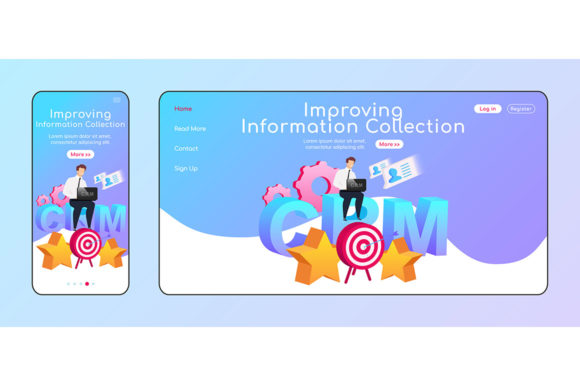
The concept extends beyond simple forms and surveys. It encompasses the entire user journey, from the moment a potential client lands on your homepage to the final conversion. This is where visual design and functional strategy intersect. Utilizing resources like an adaptive landing page flat color vector template can significantly enhance this process. These templates are not just aesthetically pleasing; they are engineered to guide user attention effectively. For instance, a design featuring an arrow in target motif subtly communicates precision and goal orientation to the visitor. When applied to both mobile and PC homepage layouts, such visual cues ensure that the call to action remains clear regardless of the device being used, reducing friction and increasing the likelihood of successful data capture.
Enhancing User Experience Through Adaptive Design
One of the most immediate benefits of refining your information collection strategy is the improvement in user experience (UX). Visitors today have little patience for cluttered interfaces or confusing navigation. A well-structured one-page website UI, perhaps featuring a professional graphic of a male with a laptop to represent productivity and focus, can instantly establish credibility. This type of imagery resonates with professionals and freelancers who value efficiency. By presenting a clean, focused interface, you signal to the user that their time is valued and that the information you are requesting is relevant.
Adaptive design plays a crucial role here. An adaptive landing page ensures that the layout adjusts seamlessly between desktop monitors and smartphone screens. This responsiveness is vital because a significant portion of web traffic now originates from mobile devices. If your information collection tools—such as contact forms, newsletter sign-ups, or feedback loops—are difficult to use on a phone, you risk losing valuable data. Flat color vector templates are particularly effective in this context because they load quickly and scale perfectly without losing resolution. This technical efficiency translates directly into higher completion rates for your forms and better overall engagement.
Streamlining Cross-Platform CRM Integration
For businesses relying on Customer Relationship Management (CRM) systems, the challenge often lies in getting data from various touchpoints into a central repository without errors or duplication. Improving information collection facilitates a smoother flow of data into your CRM webpage cross-platform design. When your front-end design elements are consistent and logically structured, the back-end integration becomes more reliable. Consider a scenario where a marketing team uses a unified visual language across email campaigns, social media ads, and the main website. This consistency reduces cognitive load for the user, making them more likely to provide accurate information.
Furthermore, having access to high-quality design assets can accelerate the deployment of these strategies. A comprehensive ZIP file containing EPS, JPG, PNG, SVG, and AI formats offers immense flexibility. Designers can edit vector files (EPS, AI, SVG) to match specific brand guidelines, ensuring that every touchpoint feels cohesive. Meanwhile, raster formats (JPG, PNG) are ready for immediate use in presentations or social media posts. This versatility allows teams to iterate quickly, testing different layouts or messages to see which ones yield the best data quality. The ability to rapidly prototype and deploy changes is a significant competitive advantage in fast-moving markets.
Practical Applications for Diverse Professionals
The utility of optimized information collection spans a wide array of professions. For educators and publishers, gathering feedback on content effectiveness is essential for continuous improvement. A streamlined survey embedded within an engaging landing page can provide deep insights into reader preferences, helping to tailor future materials. Similarly, freelancers and creators benefit immensely from efficient client onboarding processes. By using a polished, one-page UI to collect project requirements, freelancers can reduce the back-and-forth communication that often delays project starts, allowing them to focus more on creative execution.
Small business owners often wear many hats, and time is their most scarce resource. Implementing a system that automatically captures and organizes customer data frees up mental bandwidth for strategic planning. For example, a local service provider could use a mobile-optimized booking form that integrates directly with their calendar and CRM. This eliminates manual entry errors and ensures that no lead falls through the cracks. The visual professionalism of the page also reinforces trust, which is critical for local businesses competing in crowded markets.
Driving Efficiency and Reducing Friction
At its core, the goal of improving information collection is to remove friction. Every extra click, every confusing label, and every slow-loading image acts as a barrier between you and the data you need. By focusing on clarity and speed, you empower users to take action effortlessly. This is where the "arrow in target" concept becomes more than just a graphic; it represents the philosophy of directness. Your design should aim straight for the user's intent, providing them with exactly what they need to move forward.
Efficiency also extends to the internal workflow. When data is collected in a structured format from the start, analysis becomes straightforward. Marketers can segment audiences more accurately, product teams can identify pain points faster, and sales teams can prioritize leads with greater confidence. The ripple effect of clean data collection is a more agile organization capable of responding to market changes with precision.
Considerations and Strategic Fit
While the benefits are substantial, it is important to approach improving information collection with a strategic mindset. Not every situation requires a complex, fully custom solution. Sometimes, a simple, well-designed template is sufficient. Users should evaluate their specific needs before committing to a particular design direction. For instance, if your primary audience is highly technical, a minimalist flat design might appeal more than a flashy, image-heavy layout. Conversely, creative industries might benefit from more vibrant visual storytelling.
Additionally, privacy and data security remain paramount. As you enhance your collection methods, ensure that you are transparent about how data is used and stored. Trust is the currency of the digital age; once lost, it is difficult to regain. A professional appearance helps, but it must be backed by ethical practices. Always compare options and consider the long-term scalability of your chosen tools. A solution that works for a startup might need adjustment as the business grows, so flexibility is key.
Ultimately, the journey toward better data practices is ongoing. It involves a blend of thoughtful design, robust technology, and a genuine desire to understand your audience. By leveraging adaptable tools like vector templates and focusing on cross-platform compatibility, you create an environment where information flows freely and effectively. This not only supports your immediate goals but also builds a resilient infrastructure for future growth. Whether you are optimizing a single landing page or overhauling an entire CRM ecosystem, the principles of clarity, efficiency, and user-centricity will always lead to superior results.